
How Music Helps Me Reach Mum When Words Fail

Hello, welcome to another moment of clarity.
There are days now when conversation feels like something fragile. It doesn’t break all at once, it just starts to lose its shape, slipping between us in small quiet ways that are hard to hold onto.
Since dementia became part of our lives, I’ve noticed how easily words can drift out of reach. I can see the effort it takes for her to find the right one, and sometimes I catch myself doing the same, searching for something that will meet her where she is.
But more often than not, the words don’t come.
They sit somewhere just out of reach for both of us. I ask a question and she looks at me, not blankly, but almost as if she knows what she wants to say and just can’t quite find the path to it. Dementia doesn’t take everything all at once. It changes things slowly, quietly, in ways that are hard to explain unless you’re living inside it.
I used to try and fill that space. I’d rephrase things, slow myself down, try again from a different angle. Sometimes it worked. Sometimes it didn’t.
And on the days when it didn’t, everything felt heavier than it needed to be.
It took me a while to realise that maybe words weren’t always the thing to reach for.

Finding Another Way In
Music came into it gently, without any real plan behind it.
At first it was just background noise. A radio left on in the kitchen. A song playing while I tidied up. Something to make the house feel a little less quiet.
But then I started to notice small shifts.
Dementia might make conversations harder, but music seems to slip past those barriers. A foot tapping without her realising. A slight smile when something familiar comes on. The way her posture softens, just a little, as if something inside her recognises what her mind can’t quite place.
And then there’s Dancing Queen.
Her song.
The moment those opening notes start, something changes. She doesn’t hesitate. She doesn’t search.
She moves.
Not always in a big way. Sometimes it’s just her shoulders, or the way she sways slightly where she’s sitting. Other times she’ll stand up, almost instinctively, and start to dance properly, like she’s remembering something her body never forgot.
It’s one of the few moments where dementia doesn’t feel like the thing in charge.
It feels like she’s right there.

The Moments That Catch Me Off Guard
What still surprises me, even now, are the moments when she sings.
Not all the time. Not even most of the time.
But every so often, a song will come on and she’ll join in. Sometimes the words are a little off, drifting in and out of place. Other times, they come through with a kind of clarity that stops me in my tracks.
It’s never something I expect.
It just happens.
Like a window opening for a few seconds, letting something familiar through before it closes again.
This week, we went into the city centre. Nothing big, just a small day out. A bit of shopping, a change of scenery, something to break up the routine.
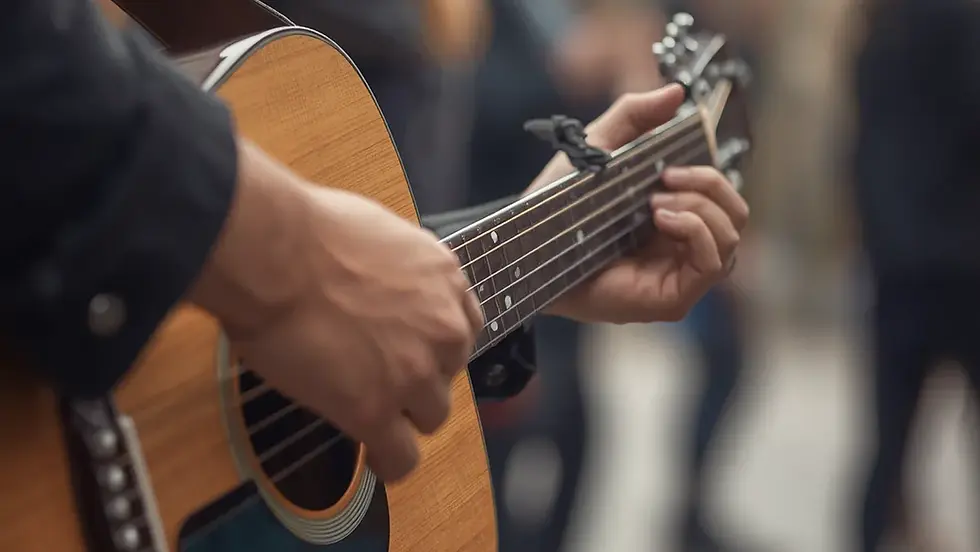
We were walking through one of the busier streets when I heard music ahead of us. A busker had set up, guitar in hand, singing to the passing crowd.
I didn’t think much of it at first.
And then I heard her.
She started singing along.
Not quietly, not hesitantly. Properly singing. Word for word, in time, completely in sync with the music. I actually stopped walking for a second because I thought I’d misheard.
I turned to look at her and she was just there, in the moment, singing like it was the most natural thing in the world.
I had to do a double take.
It caught me completely off guard.
There was no searching, no pause, no confusion. Just her voice, steady and sure, carried by something deeper than memory. It reminded me that even with dementia, not everything is lost in the way we sometimes fear.
I don’t even know if she realised what she was doing.
But I did.
And I think I’ll hold onto that moment for a long time.
What Music Seems to Do
I’ve stopped trying to explain why music works the way it does.
I don’t think I need to understand it fully to see what it gives us.
Music therapy is often talked about in dementia care, but what I’m seeing at home feels simpler than that. It bypasses something. Or maybe it reaches something that words can’t get to anymore.
When I put a song on, I’m not asking her to remember. I’m not asking her to follow a conversation or hold onto a thought. There’s no pressure in it.
She doesn’t have to get it right.
She just has to feel it.
And that seems to be enough.
I’ve started to lean into that more, especially on the harder days. When dementia makes communication feel strained, I don’t push it the way I used to.
I’ll put music on instead.
Not as a solution, but as a way of softening things.
Sometimes we sit quietly and listen. Sometimes she hums along. Sometimes she dances. And sometimes, like in the city centre this week, she surprises me completely.
It’s not about bringing things back to how they were.
It’s about finding something that still is.

Letting That Be Enough
There’s a part of me that still misses the conversations we used to have. The easy back and forth, the shared understanding that didn’t need effort.
That hasn’t gone away.
But moments like these remind me that connection hasn’t gone either. Dementia changes how it looks, but it doesn’t erase it completely.
It lives in smaller things.
In a smile when a song starts. In a few lines sung perfectly out of nowhere. In the way she moves without thinking, like her body is following a memory that doesn’t need words.
I’m learning to meet her there instead of pulling her somewhere else.
And when I do, things feel a little lighter.
Not fixed, not easy, but lighter.

A Closing Thought
I think I’m starting to understand that not everything meaningful needs to be said out loud.
Some things are felt instead. Carried in a melody, held in a familiar rhythm, or remembered somewhere deeper than words can reach.
Living with dementia has changed how we find each other, but it hasn’t taken those moments away completely. Music has become a way back, even if only for a few minutes at a time.
And those minutes matter more than I can really put into words.
So I hold onto them when they come.
And I let them be enough when they go.
Until next time,
James
If music has ever helped you connect with someone living with dementia, even in a small way, I’d be interested to hear about it. You can share it here if it feels right, or simply sit with the thought. There’s also a quiet space over on Instagram where moments like these tend to gather, if you ever feel like being part of that.


Comments