
When Your Parent With Dementia Looks to You for Safety

Hello, welcome to another moment of clarity.
One of the hardest things to explain about caring for someone with dementia is how deeply they begin to rely on your presence. Not just for practical things like meals, medication, or appointments, but for something much quieter and much heavier than that.
Safety.
There are moments now where my mum looks at me the same way a child looks for reassurance in a crowded room. Sometimes it happens after confusion settles in. Sometimes after waking up from a nap and not recognising where she is for a few seconds. Sometimes for no visible reason at all.
She looks at me to work out whether the world around her is safe.
At first, I did not fully understand what I was seeing. I thought she needed answers. I thought I needed to explain things better, calm situations faster, fix whatever had upset her. Over time, I realised that what mattered most was often much simpler.
She needed me to feel steady.
Not perfect. Not endlessly patient. Just steady enough that she could borrow some calm from me when her own sense of certainty disappeared.
That changes something inside you as a caregiver. It changes the way you move through a room. The way you speak. The way you carry your own exhaustion.
Because eventually you realise they are not only listening to your words.
They are listening to your nervous system.

Becoming a Safe Place for a Parent With Dementia
I think one of the most heartbreaking parts of dementia is knowing that the world slowly stops behaving in predictable ways for the person living inside it.
Rooms become unfamiliar. Sounds feel sharper. Conversations move too quickly. Faces blur between memory and confusion. Even ordinary routines can suddenly feel strange or threatening.
Imagine waking up every day into a world that no longer follows the rules you remember.
A kettle boiling might sound alarming. A hallway at dusk might feel unfamiliar. A simple question might become impossible to process before another one arrives behind it.
There are times when I have watched my mum look around the house she has lived in for years with uncertainty in her eyes, as though she is trying to place herself inside a reality that keeps shifting shape around her.
Dementia can turn the world into something that feels unstable and slippery. Familiar things stop holding their meaning. Time stops moving in a straight line.
And when that happens, people look for anchors.
Very often, that anchor becomes the caregiver.
Not because we always know what we are doing, but because we are the thing they recognise most consistently. Our voice. Our face. Our presence moving through the home.
We become the fixed point in a turning world.
I think that is why caregiving can feel so emotionally intense even during ordinary moments. You are not simply helping someone through tasks. You are helping them feel orientated inside reality itself.
Understanding Shadowing Behaviour in Dementia
One of the behaviours caregivers talk about often is shadowing.
That quiet moment where you stand up to go into another room and a few seconds later you hear footsteps behind you.
You go to make tea and they follow.
You fold laundry and they sit nearby watching.
You go upstairs for two minutes and hear them calling your name.
I remember feeling overwhelmed by this in the beginning. Not because I was angry at my mum, but because I felt like I could never fully exhale. There was no real separation between caring and resting. Even small pockets of privacy seemed to disappear.
Then one day I stopped looking at it as behaviour and started looking at it as communication.
If they lose sight of you, they lose sight of safety.
That changes the emotional meaning completely.
For someone living with dementia, separation can feel frightening in a way that is difficult for healthy brains to fully understand. Their ability to hold onto reassurance after you leave the room often fades. Object permanence becomes fragile. Time stretches strangely.
You leaving for thirty seconds may feel much longer to them emotionally.
So they follow because their nervous system is trying to stay close to the thing that feels safest.
That does not magically remove the exhaustion of it. There are still days when I feel touched out by responsibility and desperate for a few uninterrupted minutes alone. Caregivers are human beings too.
But reframing shadowing helped me respond with more softness.
Instead of thinking, Why can’t I have five minutes to myself?
I started thinking, They are scared of losing the one thing that still feels familiar.
That shift matters.
Why People With Dementia Absorb Caregiver Emotions
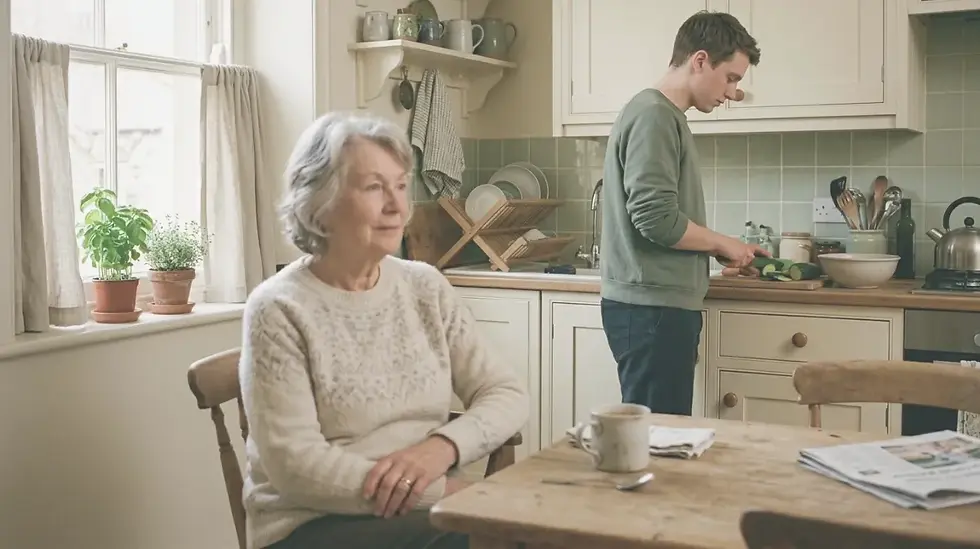
One thing I wish more people understood about dementia is how emotionally perceptive many people remain even when memory fades.
My mum may forget conversations.
She may lose track of days.
But she still senses tension immediately.
If I rush around the house stressed and frustrated, she absorbs it. If my voice sharpens slightly from exhaustion, her anxiety rises almost instantly. Sometimes she becomes restless without either of us fully understanding why.
It took me a long time to realise how connected our emotional states had become.
People with dementia often mirror the emotional atmosphere around them because logic and language become harder to rely on. Emotion becomes the clearest source of information left.
If I seem afraid, then the world must not be safe.
If I seem calm, then maybe things are okay.
That can feel like a huge pressure as a caregiver because the truth is we are not calm all the time. Some days we are overwhelmed, grieving, exhausted, isolated, financially stressed, emotionally drained.
And yet somehow we still become emotional weather systems for another person.
I do not say that to create guilt. I say it because understanding it helped me approach difficult moments differently.
Sometimes calming my mum had less to do with explanations and more to do with slowing myself down first.
Speaking softer.
Lowering the pace of the room.
Sitting beside her instead of talking across the room while multitasking.
Breathing before responding.
Not because I mastered caregiving perfectly, but because calm is contagious too.

When a Parent With Dementia Looks to You for Safety
There is a strange grief in becoming the person your parent depends on for emotional safety.
Because somewhere underneath the caregiving role, you still remember being the one who looked to them.
You remember them calming your fears.
You remember following them through supermarkets as a child because being near them made the world feel manageable.
And then one day the roles quietly reverse.
Now they look for you in crowded rooms.
They ask where you are if you step outside.
They settle when they hear your voice.
Sometimes the emotional weight of that feels enormous. Especially when you are trying to hold yourself together too.
There are days where I feel deeply honoured by the trust my mum places in me.
There are other days where it feels unbearably sad.
Both things can exist at once.
I think caregivers often carry guilt for feeling overwhelmed by being needed so constantly. But being someone’s safe place is beautiful and exhausting at the same time.
Those feelings are not opposites.
They belong together.
Why Emotional Presence Matters in Dementia Care
I used to think good caregiving meant always knowing the right thing to say.
Now I think it often means learning how to stay emotionally present inside uncertainty.
There are still moments where I get things wrong. Moments where I lose patience with myself. Moments where I wish I had responded differently.
But dementia has slowly taught me something I never expected.
People do not always remember our exact words.
They remember how we made them feel.
And for someone living with dementia, feeling safe can matter more than understanding every detail around them.
That safety might look like familiar music playing softly in the background.
A calm tone of voice.
A hand resting gently on theirs.
A routine repeated enough times to feel dependable.
Or simply knowing someone they trust is nearby.
Sometimes the smallest things become the strongest forms of reassurance.

A Closing Thought
I do not think people realise how much of dementia care, especially when a parent looks to you for safety, revolves around creating emotional safety in invisible ways.
Not through perfect routines or having every answer, but through presence.
Through becoming familiar enough that another person can rest their fear beside you for a little while.
That responsibility can feel heavy. Some days it may even feel impossible. But if you are showing up with gentleness, even imperfectly, you are already offering more safety than you probably realise.
And maybe that is one of the quiet truths inside caregiving.
Sometimes being the safe place for someone does not mean removing all fear from their world.
Sometimes it simply means they do not have to face it alone.
Until next time,
James
Have you noticed moments where your parent seems calmer simply because you are nearby? If this piece felt familiar, you are welcome to share your experience in the comments. I also share these quieter reflections over on Instagram, where this space continues in smaller everyday moments.


Comments